
TL;DR
|
The Journey From Contract to Contribution
Most vehicle and equipment OEMs invest heavily in managing dealer contracts, dealer standards and network administration.
Far fewer invest in managing the entire dealer lifecycle.
That's understandable. For decades, dealer network management has largely been viewed as a series of operational activities: onboarding a new dealer, processing contract amendments, managing network changes, conducting dealer visits and reviewing performance. Different teams often own different parts of the process, supported by different systems, spreadsheets and reporting tools.
The challenge is that dealers don't experience these activities as separate events. They experience one continuous relationship with the OEM.
As dealer networks become more complex, compliance requirements increase and dealerships have an ever-growing number of choices for OEM partner, OEMs are discovering that managing individual processes well is no longer enough. What matters is how effectively those processes connect and how easy there are to deal with.
This is where dealer lifecycle management comes in.
Rather than treating dealer onboarding, network operations and performance management as separate activities, dealer lifecycle management takes a connected approach that creates visibility, accountability and consistency across the entire dealer journey.
The result is not simply better administration. It's stronger dealer relationships and improved network performance resulting in greater contribution to the business.
Has Dealer Network Management Outgrown Traditional Administration?
Traditional dealer network management focuses on maintaining the network. Dealer lifecycle management focuses on continuously developing it.
A modern dealer lifecycle typically consists of five interconnected stages: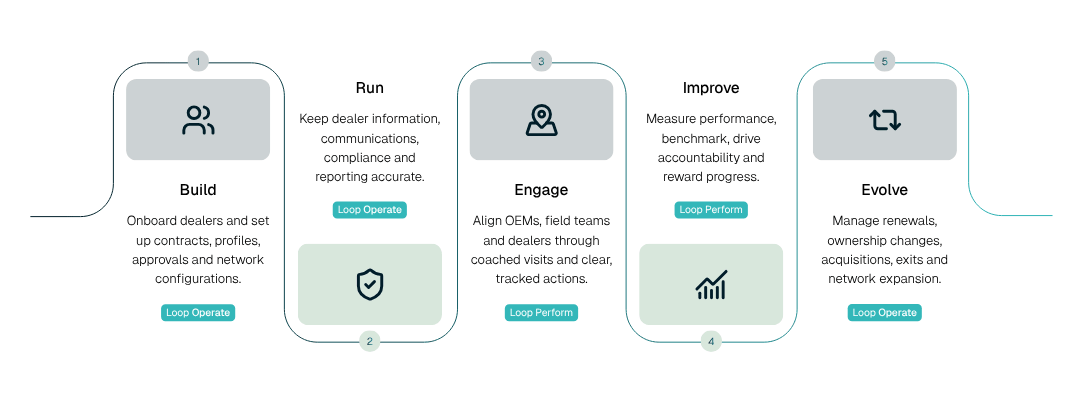 Stage 1: Build
Onboard dealers and set up contracts, create profiles, assign areas, tag bodyshops and configure the network.
Stage 2: Run
Align OEMs, field teams and dealers through coached visits and clear, tracked actions. Improving outcomes together.
Stage 3: Engage
Manage renewals, ownership changes, acquisitions, exits and network expansion.
Stage 4: Improve
Make insight available to dealers, measure daily performance, benchmark, drive accountability and reward progress.
Stage 5: Evolve
Keep dealer information, communications, compliance and reporting accurate.
Historically, these stages have often been managed independently. For example, the onboarding team completes its work and hands over to network operations. Network operations hand over to field teams. Field teams focus on performance reviews. Compliance teams conduct audits. Commercial teams manage renewals.
Each team performs its role effectively, but the connections between stages are often the weak link.
This creates lifecycle gaps that impact both the OEM and the dealer experience.
What's Broken With the Current Approach?
The challenge isn't the process itself. It's that dealer networks have become more complex, while the tools used to manage them have often evolved independently.
Historically, there simply wasn't a way to manage the entire dealer lifecycle as one connected process. Today, that's changing.
For Head Office Teams
Network operations teams often find themselves managing dealer information across multiple systems. Dealer profiles sit in one platform. Contracts sit somewhere else. Approval workflows are managed through email. Reporting is built in spreadsheets.
This creates:
-
Duplicate records
-
Approval bottlenecks
-
Limited governance
-
Complex and time consuming audits
-
Multiple versions of the truth
When a dealer changes ownership, expands territory or updates key personnel, the impact can ripple across numerous systems and teams and without that single connection, this can result in inaccurate information being utilised by key suppliers.
For Field Teams
Area managers and field teams frequently spend more time preparing for dealer visits than conducting meaningful coaching conversations. Performance data is spread across different reports. Historical actions sit in email chains. Notes are stored locally. As a result, highly skilled teams spend valuable time gathering information instead of helping dealers improve performance.
For Dealers
Dealers often receive multiple requests for information from different OEM departments, leading to:
-
The same information is submitted multiple times.
-
Communications are inconsistent.
-
Responsibilities can become unclear.
How Can OEMs Run Their Networks More Effectively?
The foundation of effective dealer lifecycle management is operational excellence. Before performance can improve, the network itself must be managed efficiently.
This means addressing common challenges such as:
-
Slow dealer onboarding
-
Contract administration complexity
-
Multiple approval processes
-
Governance and compliance requirements
-
Dealer acquisitions and ownership transfers
-
Network changes
-
Dealer exits and renewals
-
Fragmented communications
-
Outdated dealer information
The impact varies across industries but the challenge is remarkably similar.
 |
 |
.png?width=500&height=500&name=agri%20(1).png) |
 |
| An automotive OEM may be onboarding a new retail partner while simultaneously managing franchise transfers. | A motorcycle brand entering a new market may need to rapidly establish and govern a dealer network from scratch. | An agricultural equipment OEM may need visibility of seasonal dealer coverage across large geographic territories. | A commercial vehicle OEM may need to ensure workshop capability & operational readiness across critical service sites. |
The common requirement is clear: accurate information, structured processes and visibility across the entire network. This is where an operational platform like Loop Operate becomes critical.
By centralising dealer profiles, contracts, communications, workflows and approvals in one governed environment, OEMs can create a single source of information for the network. Instead of relying on periodic reviews, they gain a continuous understanding of network health and activity. Issues are identified earlier, changes are managed faster and compliance becomes easier to demonstrate.
Most importantly, everyone works from the same information.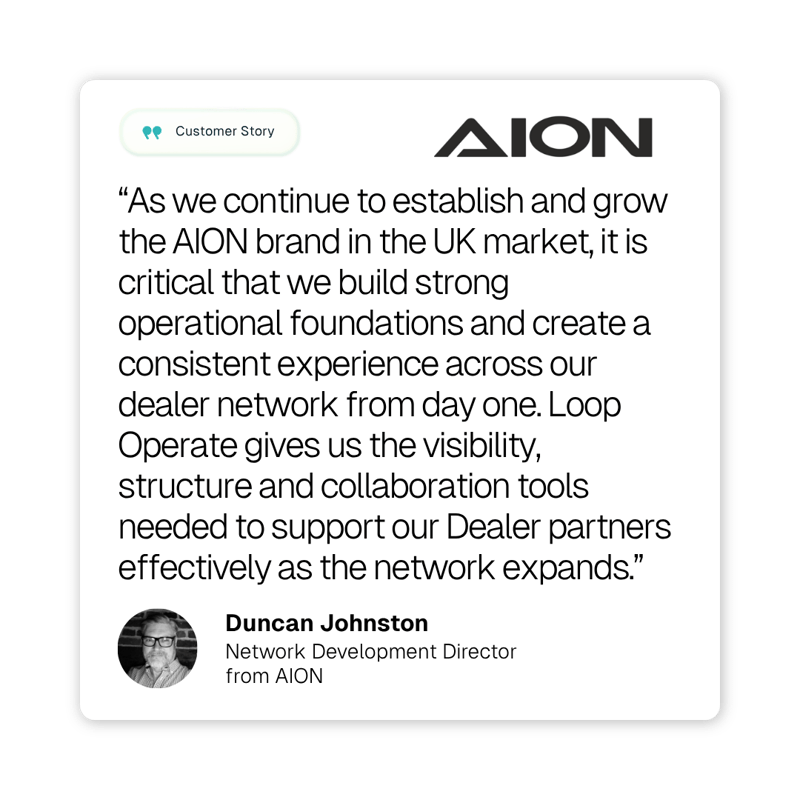
Why Is Dealer Performance Still So Challenging to Improve?
Even when operational foundations are strong, many OEMs still struggle to consistently improve dealer performance. The reason is simple. Visibility alone does not create improvement.
Many organisations have access to more performance data than ever before, yet still face challenges such as:
-
Disconnected KPI reporting
-
Lack of daily visibility of key metrics
-
Delayed performance insights
-
Inconsistent benchmarking
-
Limited accountability
-
Unreliable bonus programs
-
Difficulty tracking actions
-
Slow intervention when issues emerge
Across every sector, the pattern is familiar.
|
|
|
|
| Automotive brands need to identify declining customer experience scores before they impact retention. | Motorcycle manufacturers need greater visibility of sales conversion and market growth opportunities. | Agricultural OEMs need to understand how dealer capability influences customer outcomes. | Commercial vehicle networks need to monitor service performance and uptime across dealer locations. |
The challenge is rarely a lack of data, instead, it’s converting that data into information and action.
Leading OEMs increasingly combine performance visibility with structured accountability. Instead of simply reviewing KPIs, they connect performance metrics to actions, owners and measurable outcomes. This is where Loop Perform changes the conversation.
By bringing KPI visibility, dashboards, scorecards, benchmarking and action management together, OEMs can move beyond reporting and focus on improvement.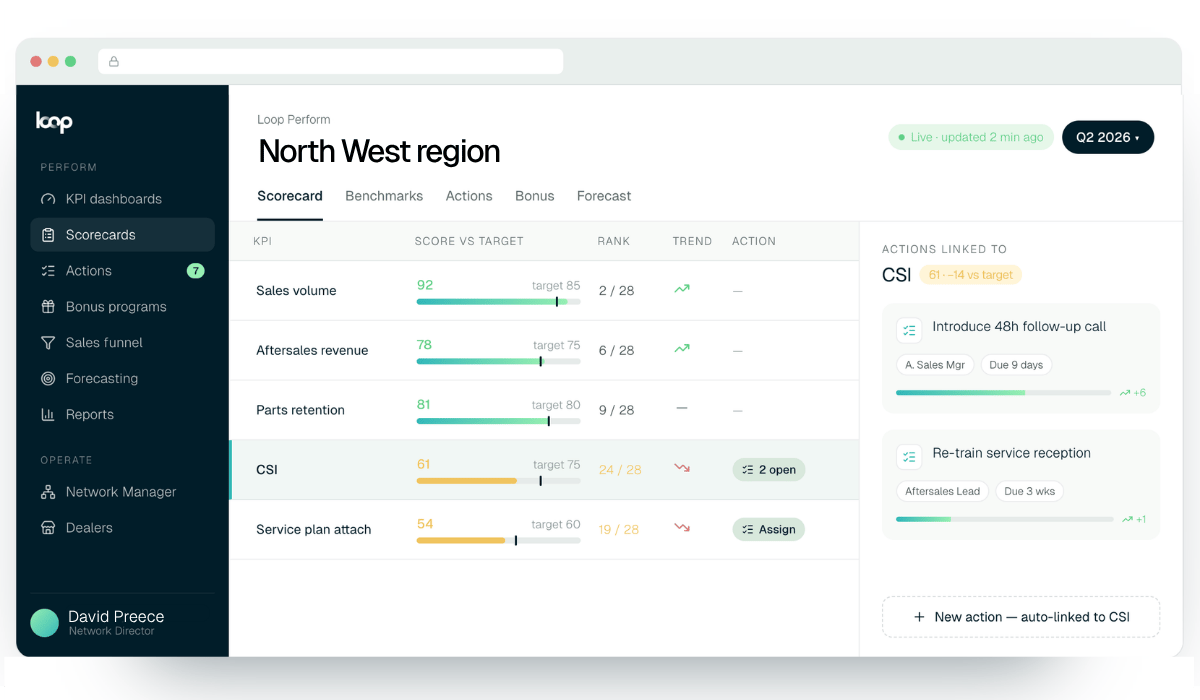
The impact can be significant.
-
Volkswagen Group achieved a 10% performance improvement across the group using Loop.
-
AGCO analysts reduced manual reporting effort by 75%, allowing them to focus more time on performance strategy and network improvement.
When everyone can see performance, understand priorities and track progress, accountability becomes part of the operating model rather than an annual exercise.
Why You Should Maximise the Value of Each Dealer Visit
Dealer visits are one of the most valuable moments in the OEM-dealer relationship. Yet too often they become administrative exercises:
-
Field teams spend hours preparing before and sharing reports afterwards
-
Performance data is collected from multiple sources
-
Meeting notes are recorded in different locations
-
Actions are agreed verbally and later forgotten
-
Audit processes become lengthy and difficult to manage
This affects every sector.
Whether reviewing showroom standards at a motorcycle retailer, aftersales performance at a commercial vehicle dealer or customer experience scores within an automotive franchise, the challenge is the same. Too much effort goes into administration and not enough into improvement. Modern dealer lifecycle management changes this dynamic.
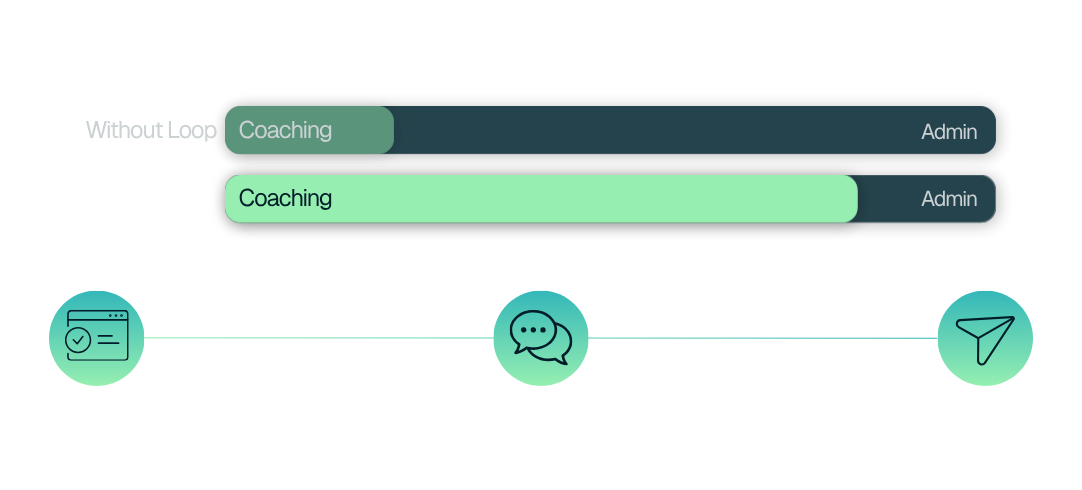
Field teams should be able to prepare for visits in minutes rather than hours. Best practice can be achieved with Loop Perform, providing:
-
Performance history, benchmarks and previous actions to be available
-
Editable, templated agendas
-
Ability to assign actions during the discussion
-
Dealers with visibility of expectations, ownership and progress – they see what you see
The result is a better conversation focused on outcomes rather than paperwork. Field teams spend more time coaching and dealers gain greater clarity. Resulting in faster performance improvements.
Why Dealer Lifecycle Management Requires Both Operations and Performance
This is where many dealer network transformation initiatives fall short. Operational management and performance management are often treated as separate disciplines. In reality, they are dependent on each other.
Without strong operational foundations, performance data lacks context. Without performance management, operational excellence never translates into commercial outcomes.
The most effective OEMs connect both by creating:
-
A trusted operational foundation that supports visibility, accountability and continuous improvement
-
One shared view of the same information for head office teams, field teams and dealers
-
Connected workflows, not fragmented processes
-
Continuous visibility rather than periodic reviews
-
Better dealer conversations that ultimately lead to stronger customer experiences and improved profitability
From Contract to Contribution
Dealer network management is evolving. The future is not simply about managing contracts, maintaining records or conducting performance reviews. It is about managing the entire dealer lifecycle as one connected journey.
From onboarding to renewal. From governance to growth. From contract to contribution.
OEMs that take this approach gain more than operational efficiency. They create stronger dealer partnerships, improve accountability and build the foundations for long-term network performance.
The question is no longer whether dealer lifecycle management matters. The question is whether the systems and processes supporting your network are helping you manage it as one connected whole.
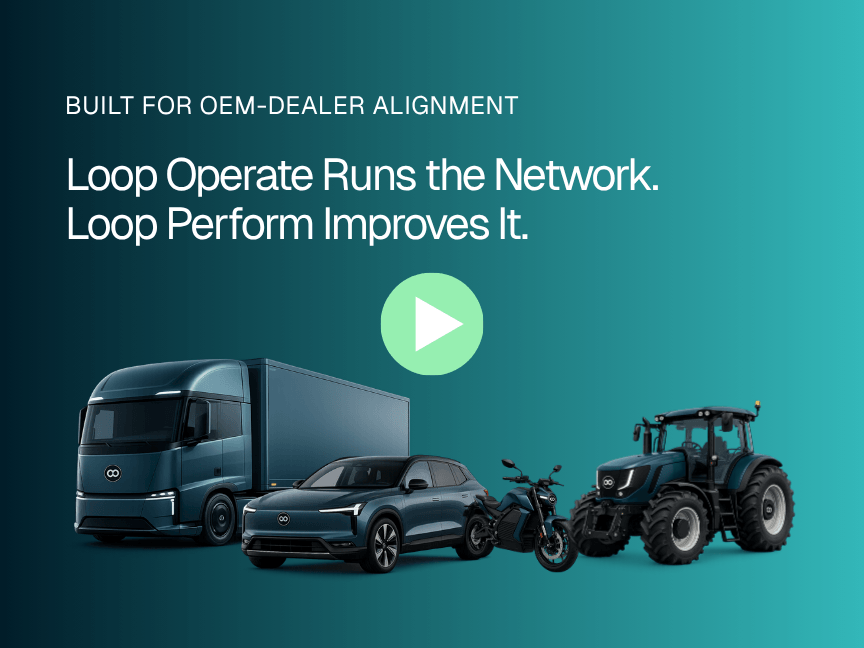
See how Loop Operate & Loop Perform connect:
Frequently Asked Questions
.png?width=1000&height=250&name=blog-cta-Loop%20(1).png)