
TL;DR
|
Why Aftersales Performance Matters When Entering New Markets
Launching into a new market is about more than establishing a dealer network and generating sales. For vehicle and equipment OEMs, developing a strong aftersales operation is essential to building customer trust, supporting dealer profitability and creating long-term stability.
Every vehicle or machine sold represents a customer relationship to maintain. Whether it's a family car, motorcycle, agricultural machine or commercial vehicle, customers need confidence that servicing, repairs, technical expertise and replacement parts will be available when required.
But the priorities for a brand launching in a new territory can differ significantly from those of an entrant that's already expanding its operations.
For new market entrants, the immediate challenge is establishing the foundations: suitable facilities, trained technicians, reliable parts supply, warranty processes and accessible customer support.
For growing market entrants, the focus increasingly shifts towards maintaining consistency, managing service demand, improving dealer performance and strengthening customer retention.
The challenge is developing an aftersales strategy that meets today's requirements while remaining flexible enough to evolve alongside the brand.
In the Loop: Building Aftersales from the Ground Up with AION
AION's entry into the UK automotive market offers an interesting example of how an established global manufacturer can approach the challenges of launching in a new territory.
Backed by GAC, an established automotive manufacturer with experience and product data from other markets, AION has been able to draw on that knowledge while building the infrastructure, systems and processes required specifically for the UK.
Speaking to Loop's Laura Williams, Ben Hurford from AION explains why a successful aftersales operation needs to be connected from the outset.
Rather than treating parts, technical support and customer service as separate functions, the business has focused on bringing these elements together to deliver a seamless ownership experience.
AION has also used performance data from established markets to inform its UK parts strategy. At the time of recording, Ben reported that the business had established a functioning parts warehouse and achieved a 100% parts fulfilment rate.
Importantly, its approach recognises that many retail partners are established, multi-brand businesses. Making processes, communications and technical information easy to access is therefore central to supporting those dealers.
Loop’s Automotive Advisory Partner, Laura Williams and AION's Aftersales Director, Ben Hurford, discuss the importance of a solid aftersales strategy when entering a new market.
The wider lesson for OEMs is that market entry provides an opportunity to design aftersales operations around current customer needs, rather than simply replicating established processes.
So, what should OEMs prioritise when developing aftersales performance in a new market?
Here are six practical considerations.
1. Establish Consistent Aftersales Standards from Day One
Aftersales standards define the minimum capabilities and customer experience expected across the dealer network. For brands entering new markets, the priority should be operational readiness rather than introducing an unnecessarily complex standards programme.
For new market entrants: Define what must be ready before launch
Start by separating essential launch requirements from standards that can develop as the market grows. Consider three core areas:
-
Facilities: Can customers access suitable service locations with the necessary workshop equipment and diagnostic tools?
-
Technical capability: Are technicians trained and accredited, with clear routes to obtain additional technical support?
-
Parts supply: Can dealers obtain the parts needed to complete servicing and repairs within acceptable timescales?
These priorities reflect the approach described by Ben at AION, who emphasises the importance of facilities, technical expertise and timely parts availability.
Service coverage also deserves attention. A dealer network may provide good geographical sales coverage without necessarily offering customers convenient access to aftersales support.
For an agricultural machinery OEM, this might mean prioritising service coverage in key farming regions and ensuring technicians can support equipment during critical seasonal periods.
For a motorcycle manufacturer, it could mean preparing service facilities and technician capability ahead of the main riding season.
Use structured readiness assessments to identify which dealers can begin supporting customers and which still require equipment, training or operational support.
For growing market entrants: Prepare for increasing service demand
As the number of vehicles or machines in operation increases, review whether dealer capacity is keeping pace with demand.
A dealer that initially required one accredited technician may need additional technical capacity as more products enter the local market. Similarly, workshop availability, parts stocking requirements and geographical coverage may need to change as the installed customer base grows.
Review standards regularly, considering both compliance and operational effectiveness.
Where requirements are no longer appropriate, update them consistently across the network while allowing for differences in dealer size, location and customer demand.
A centralised approach to dealer onboarding, standards assessments and evidence capture helps OEMs maintain visibility as new partners join the network.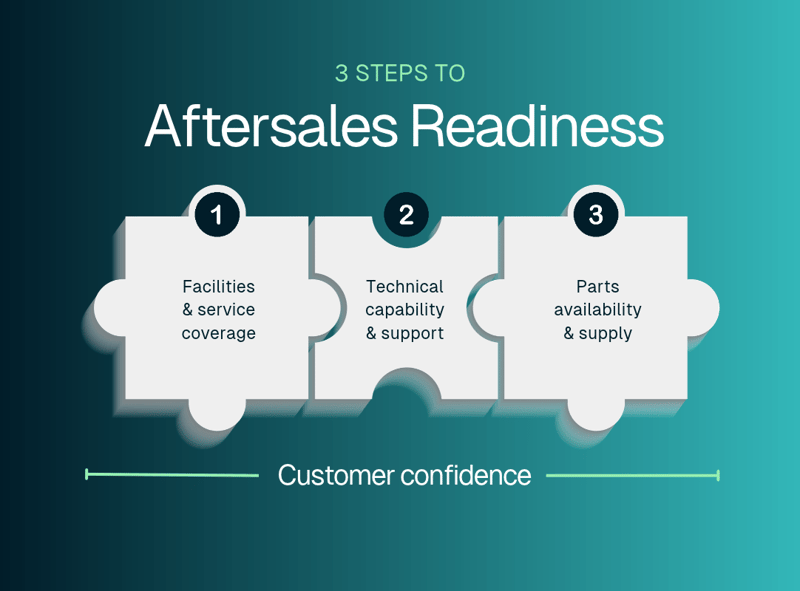
2. Choose Aftersales KPIs That Reflect Your Market's Maturity
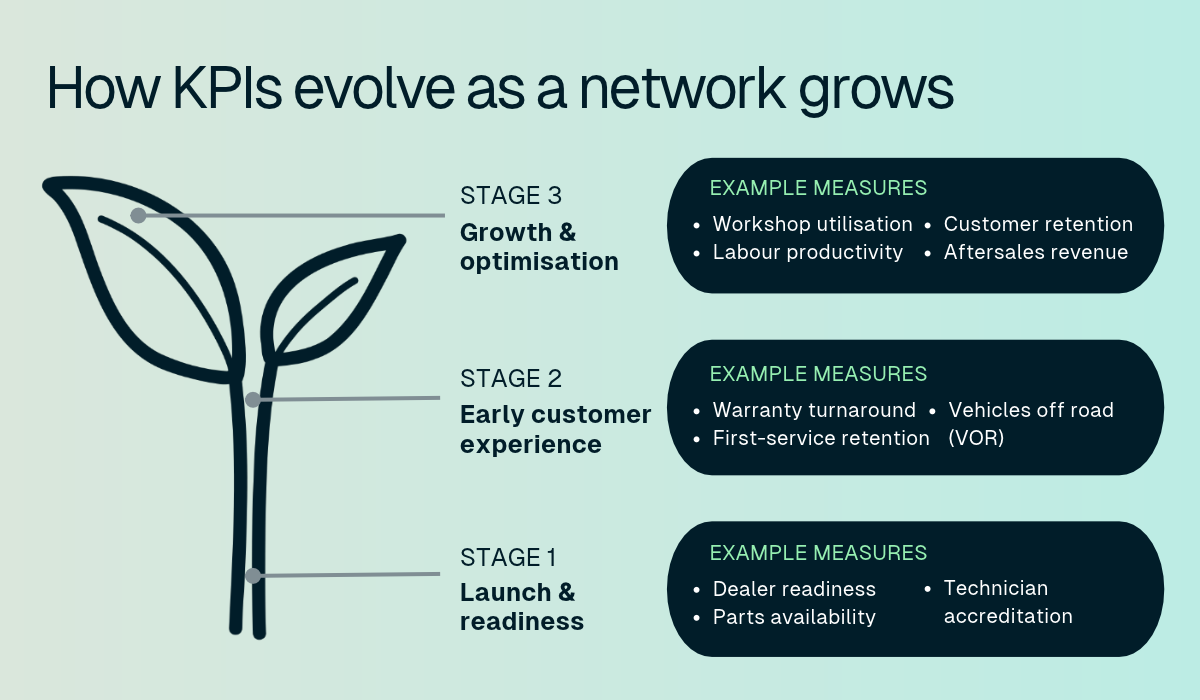
Measuring aftersales performance is essential, but traditional commercial KPIs may offer limited insight during the earliest stages of market entry. The priority is to measure what can meaningfully influence performance today, then introduce more sophisticated measures as the network develops.
For new market entrants: Measure capability and operational readiness
With limited service history and a relatively small customer base, measures such as overall service retention and workshop profitability may not yet provide meaningful comparisons.
Instead, focus on early indicators that show whether dealers can deliver the expected aftersales experience. For example:
| Early-stage KPI | What it helps OEMs understand |
| Dealer aftersales readiness | Whether appointed dealers meet essential operating standards |
| Technician training and accreditation | Whether the network has the required technical capability |
| Parts availability | Whether replacement parts are accessible when needed |
| Warranty turnaround time | How efficiently warranty work is being processed |
| Vehicles off road (VOR) / equipment downtime | Whether customers are experiencing extended periods without their products |
| First-service retention | Whether customers return to the authorised network for their first scheduled service |
Warranty process readiness and completion rates can also be monitored as activity begins.
Don't introduce KPIs simply to populate a dashboard. Establish clear definitions, data sources, ownership and realistic initial targets.
Where the OEM already operates in other markets, existing performance data can help inform early planning.
AION, for example, used product performance information from established markets alongside local knowledge to determine the breadth and depth of parts required for its UK operation.
Other brands may have less historical information available, making it particularly important to establish reliable baseline measurements from the outset.
For growing market entrants: Shift towards productivity, retention and profitability
As customer volumes increase, introduce measures that reflect the network's developing commercial performance.
These might include workshop utilisation, labour productivity, first-time fix rates, customer satisfaction, aftersales revenue and service retention.
However, avoid applying identical targets to every dealer.
A recently appointed commercial vehicle dealer supporting a small local fleet population will have different opportunities from an established operation serving a large commercial customer base.
Use appropriate peer groups and consider factors such as dealer maturity, product mix, customer volumes and territory.
The objective is to understand where performance can improve, not simply to produce a network ranking.
3. Identify Performance Differences and Focus Resources Where They'll Have the Greatest Impact
As a new network develops, some dealers will progress more quickly than others. Understanding these differences helps OEMs prioritise support, particularly when central and field team resources are limited.
For new market entrants: Identify the most significant capability gaps
During launch, focus on operational differences that could directly affect the customer experience.
For example, one dealer may have completed all technical training but still be waiting for specialist diagnostic equipment. Another may have the necessary facilities but be experiencing difficulties processing warranty claims.
Rather than treating every gap as equally urgent, assess its likely impact.
Prioritise dealers where customers could face delays accessing servicing, repairs or essential technical support.
Geographical coverage matters too. A capability gap in a sparsely populated agricultural or commercial vehicle territory could have a greater customer impact than a similar issue in an area with several alternative service locations.
A central view of readiness, outstanding requirements and support activities allows OEMs to allocate resources more effectively.
For growing market entrants: Investigate disparities, not just underperformance
Once reliable performance data is available, compare dealers to understand why results differ.
For example, two workshops might handle similar repair volumes but achieve different warranty turnaround times.
Investigating the reasons could reveal differences in technician training, parts ordering, workshop scheduling or access to technical guidance.
Look for patterns across comparable dealers, then identify where support is likely to make the greatest difference.
This is particularly valuable for OEMs with relatively small field teams covering large territories.
As Jim Newman, Area Aftersales Manager at Audi, explains: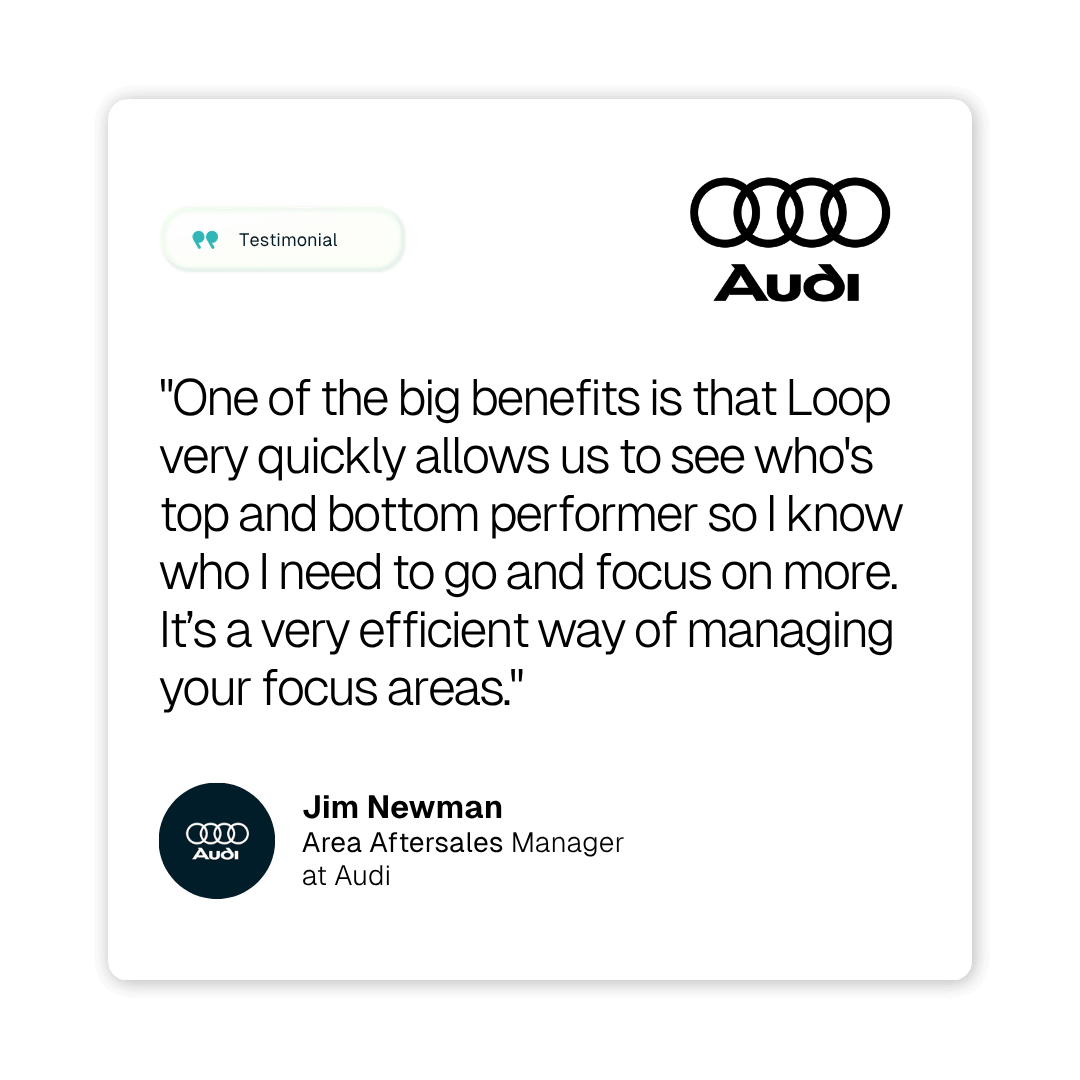 The aim is to use performance insights to focus attention where it will have the greatest impact, rather than spreading resources evenly across the network.
4. Turn Dealer Visits into Opportunities for Aftersales Improvement
Field teams are central to developing dealer capability, but their time is valuable. Visits should be planned around the specific needs of the dealer and result in clear, measurable improvement activities.
For new market entrants: Focus on coaching and capability development
Newly appointed dealers may already be experienced aftersales operators, but they still need to become familiar with a new manufacturer's products, systems and procedures.
Use early visits to understand how confidently dealer teams can work with the brand. For example:
-
Can technicians access and use the manufacturer's diagnostic information?
-
Are warranty claims being submitted correctly?
-
Do dealer teams understand the technical support and escalation processes?
-
Are there recurring questions or difficulties that could be resolved through additional guidance?
Avoid overwhelming dealers with extensive action plans during the launch phase.
Instead, agree a manageable number of priorities that will help them become operationally confident.
Where several dealers experience the same problem, consider whether the central process needs improving rather than repeatedly addressing the issue through individual visits.
For growing market entrants: Use data to make visits more targeted
As the network expands, field teams need to move beyond a standard visit schedule and agenda.
Use aftersales KPIs, standards assessments and previous action plans to determine where support is most valuable.
For example, if a dealer's first-service retention falls below expectations, use the available customer and service data to investigate why.
Are customers receiving timely reminders? Is workshop availability affecting booking times? Are customers choosing alternative service providers?
Agree a focused improvement plan with the dealer, assigning clear responsibilities and deadlines.
These might include changes to the dealer's booking process alongside additional training or support provided by HQ.
Review progress against retention trends and, where similar issues appear across multiple dealers, consider whether a wider network initiative is needed.
Importantly, actions shouldn't sit solely with dealers. OEMs must also take responsibility for providing the training, resources and operational support needed to deliver improvements.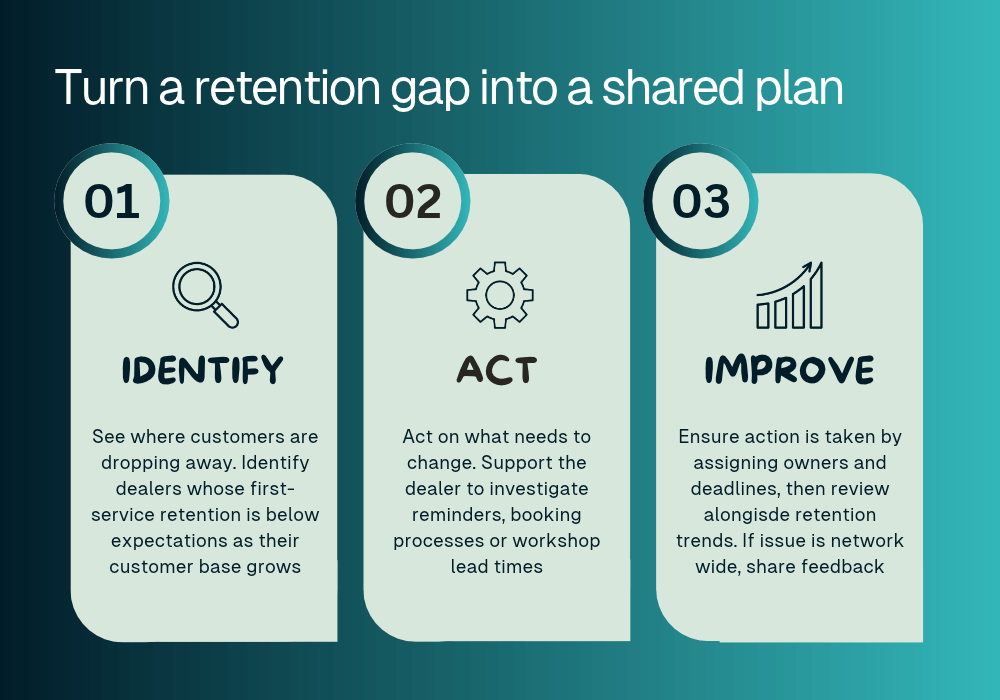
5. Nurture a Collaborative Approach with Your Dealer Network
Building a successful aftersales operation requires collaboration between the OEM and its dealers. Clear communication and easy access to information are especially important when dealer teams represent multiple manufacturers.
For new market entrants: Make your brand easy to work with
Established retail partners often provide valuable facilities, experience and customer relationships when a new manufacturer enters a market.
However, those same partners may already manage several brands, each with its own systems, processes and communications.
Ben highlights this challenge at AION. With relatively low workshop throughput during the early stages, technicians are trained on AION products but are not necessarily working on them every day.
That makes simplicity essential.
Give dealer teams a central reference point for technical guidance, warranty procedures, operational updates and training information.
Avoid requiring them to search through emails or multiple systems to find what they need.
AION is using Loop to provide access to published information and communicate directly with its dealer network.
Ben explains the importance of balancing essential updates with information that is useful but less urgent:
"We have to balance what's super critical that they must know versus what would be nice to have."
For time-sensitive communications, such as important technical or software updates, target the relevant people and monitor whether the information has been seen.
This allows OEM teams to follow up where necessary without overwhelming every dealer contact with unnecessary messages.
For growing market entrants: Turn dealer experience into shared knowledge
As the network develops, dealers become an increasingly valuable source of insight.
Create opportunities for them to share what works, identify recurring challenges and suggest improvements.
For example, a motorcycle OEM might identify successful approaches to seasonal service scheduling that could be adopted by other dealers.
An agricultural machinery manufacturer could share practices that help dealers prepare for peak maintenance demand.
Importantly, communication should work both ways.
Ben describes AION's intention to remain open to dealer feedback about processes, systems and how partners interact with the brand.
This collaborative approach helps OEMs improve the experience for dealers as well as customers.
Centralising communications, operational resources and shared guidance also makes it easier to maintain consistency as the network grows.
6. Build Continuous Improvement into Your Aftersales Strategy
Aftersales requirements don't stand still. As customer volumes, product ranges and dealer capabilities evolve, OEMs need to adapt their performance measures, operational processes and improvement priorities.
For new market entrants: Learn quickly and refine your approach
Market entry provides an opportunity to establish processes without the constraints of a large existing operation.
However, even with extensive planning, some requirements will only become clear once dealers begin supporting customers.
Introduce regular reviews of dealer readiness, warranty activity, technical support requirements and customer feedback.
Look for recurring issues that could indicate a need to change a central process.
For example, if several technicians are struggling to find the same repair information, improving how that guidance is accessed may be more effective than providing repeated individual support.
AION has used Loop to make detailed repair information searchable by diagnostic trouble code, helping technicians locate relevant guidance without manually navigating lengthy technical documents.
This demonstrates the value of adapting processes to current market needs rather than waiting for every long-term system to be fully established.
For growing market entrants: Use accumulated insight to support sustainable growth
As the network matures, move from establishing operational capability towards improving commercial and customer outcomes.
Review whether the KPIs introduced at launch still reflect the brand's priorities.
Introduce more advanced performance measures where sufficient data exists, and use historical trends to assess whether improvement activities are delivering results.
Consider how changes in product technology and servicing requirements may affect the commercial model.
For example, Ben highlights that electric vehicles can require less frequent servicing, creating fewer customer touchpoints and potentially reducing traditional parts and labour opportunities for dealers.
For OEMs introducing products with different maintenance requirements, aftersales growth may therefore depend on improving customer retention, operational efficiency and the value delivered through each interaction, rather than simply increasing workshop visits.
As Rachel Giffin, National Aftersales Manager Automobile at Suzuki GB, explains: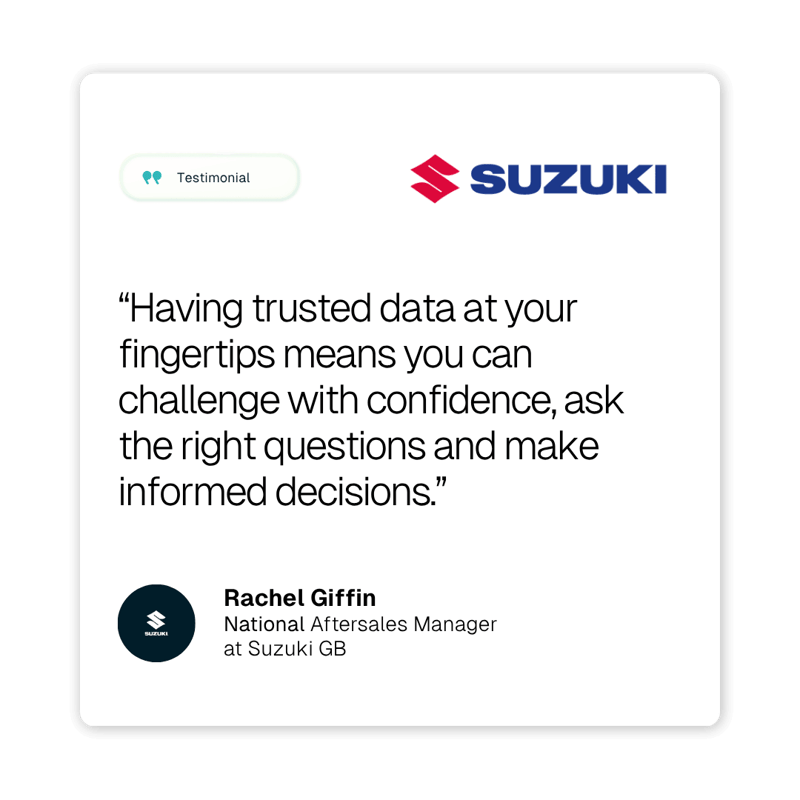 The most effective aftersales strategies combine reliable performance information, dealer feedback and clear improvement actions.
That approach helps OEMs continue developing their networks without losing sight of the customer experience.
Building an Aftersales Operation That Grows with Your Brand
Successful market expansion requires an aftersales strategy that supports the brand from its first customer through to a mature, profitable dealer network.
For new entrants, the immediate priority is establishing confidence through operational readiness, reliable parts supply, technical capability and accessible customer support.
As networks grow, the emphasis shifts towards improving consistency, developing dealer performance, strengthening retention and identifying new commercial opportunities.
The approach will differ between automotive, motorcycle, agricultural machinery and commercial vehicle OEMs, but the principle remains the same: aftersales operations need to evolve alongside the brand and its customers.
Loop helps vehicle and equipment OEMs bring aftersales performance measures, dealer readiness assessments, visits and improvement actions together, giving HQ, field teams and dealers a shared view of priorities and progress.
With a modular approach, brands can begin by managing the operational requirements that matter most at launch, then introduce additional performance measures and capabilities as their networks mature.
Discover how Loop can help you build, measure and improve aftersales performance as your dealer network grows.
Growing Aftersales Performance in New Markets FAQs